Tensioning Device | Functions of Tensioning Device | Requirements of Tensioning Device
Tensioning Device
Tensioning device, a device to detect thick spots or slubs in the yarn & a stop motion which causes thewinding to stop in the case of a yarn break or the depletion of a supply package. The yarn is directed into this zone by a guide.
Functions of Tensioning Device:
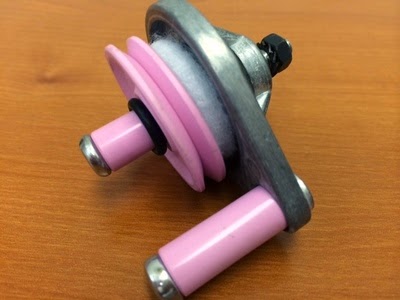 |
| Tensioning device |
- To allow the maintenance of proper tension in the yarn in order to achieve a uniform package density.
- The tensioning device also serves as a detector for excessively weak spots in the yarn which break under the added tension induced by the tension device.
- Too high tension may damage the yarn whereas too low tension can lead a unstable packages which will not unwind cleanly.
- In case of man made fiber high tension can cause molecular change which affects the dye ability, so that variations in tension ultimately show as apparently random variation in color shading.
- In case of winding staple yarns, yarn tension may break thin place of yarn.
Requirements Which Influence the Choice of Tensioning Device:
- The device must be reliable.
- It must be easily threaded.
- It must neither introduce nor magnify tension variations.
- It must not introduce difference in twist.
- It must not be affected by wear.
- It must be easily adjustable.
- It must not be affected by presence of oil or dirt.
- It must not encourage the collection of dirt & lint.
- It must be capable of easy cleaning.
- The operating surfaces must be smooth.
- It must be inexpensive.
- Depending on the type of the working member acting on the yarn.
- According to the working principle.
- Ball type.
- Washer type.
- Disc type.
- Roller type.
- Comb type.
- Two zone type.
- Capstan (multiplicative) tensioner.
- Additive tensioner.
- Combined tensioner.
- Automatic tensioner.


No comments:
Post a Comment